Wicker Park Neighborhood Guide: The Local Guide
Six corners, the 606, and a shot of Malort: what's true about the neighborhood everyone thinks they already know, and what its rising rents cost the people who built it.
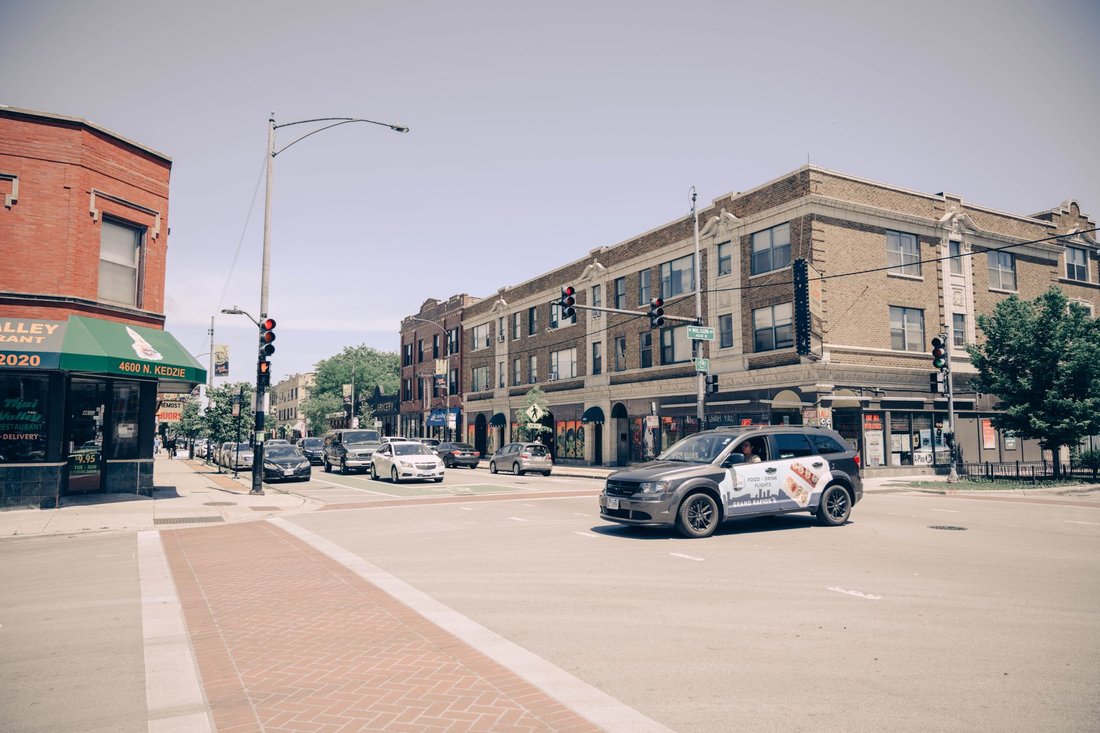
Six corners of Milwaukee, North, and Damen behaves like an intersection nobody fully designed. Cars merge at odd angles, the light cycles feel improvised, and pedestrians read three crosswalks at once just to get across. Start any wicker park neighborhood guide there, because that tangle of streets is the neighborhood distilled: three grids from three different eras of the city, still colliding, still working, more or less, every rush hour.
What a Wicker Park Neighborhood Guide Gets Wrong If It Skips the History
The neighborhood earned its reputation as an artist enclave the hard way, back in the 1980s and 90s, when cheap rents pulled painters, musicians, and small galleries into old warehouse space west of the park. The Flat Iron Arts Building, the wedge-shaped brick landmark where Milwaukee and Damen meet, still holds working studios upstairs, a physical reminder of what the area was before it became one of the more expensive rental markets on the North Side. That churn reflects a citywide pattern too. Chicago remains among the most segregated big cities in the country, and the same money that priced out this neighborhood's artists has largely stayed clustered on the North Side, while investment on the South and West Sides moves at a different pace entirely. None of what happened here is unique to Wicker Park. It's the same story that played out in Logan Square and the West Loop, just further along here.
The Park, the Trail, and How People Actually Move Through Here
Wicker Park the park is smaller than visitors expect, a compact green square that anchors the neighborhood's western edge, ringed by the kind of ornate greystones that made this a fashionable address for German and Scandinavian merchants back when the area was first platted. It's not a destination so much as a pause, a place people cut through on the way somewhere else.
The 606 changed that math. The trail runs along a former rail line, cutting east-west a full story above street level, and it gave the neighborhood something it never quite had before: a sustained view of itself from above. Runners and cyclists use it as a spine that connects Wicker Park to Bucktown, then carries west toward Humboldt Park. Stand on it at dusk and the skyline holds light longer than the streets below do, the way the lake pulls the sunset out.
A Practical Wicker Park Neighborhood Guide to Getting Around
The Blue Line's Damen stop drops riders a block from six corners, which makes the neighborhood one of the easier car-free destinations on the northwest side. Most of what matters here is walkable from that stop: the shopping stretch along Milwaukee Avenue, then the quieter residential blocks toward the park itself, with the bars clustered off near North Avenue. Bucktown, immediately north, blends into Wicker Park so completely that longtime residents argue about where one ends and the other begins. Don't expect a hard border. There isn't one.
Eating and Drinking Like You Live Here
Order a hot dog anywhere in this city and skip the ketchup. It's not a suggestion. The Chicago dog comes loaded with yellow mustard, onion, relish dyed an unnatural green, tomato, a pickle spear, sport peppers, and a dash of celery salt, and adding ketchup to that arrangement earns you a look from whoever's behind the counter. Italian beef, dipped in its own jus and topped with giardiniera, is the sandwich to order when a couple of napkins and no shame are on the table. Deep dish gets the tourist attention, but it's a special-occasion dish, not a daily one. Tavern-style thin crust, cut into squares, is what actually gets ordered on a Tuesday.
Wicker Park's bars lean toward the shot-and-a-beer end of the spectrum more than its reputation for cocktail lists suggests. You can find a good neighborhood coffee shop on nearly every block near six corners, but the neighborhood's after-dark identity still runs through its dive bars, the kind of places that pour Malort as a dare and mean it. If someone hands you a shot of it and says it tastes like grapefruit, they are lying, and they know it.
Wicker Park Fest and the Rest of the Calendar
Wicker Park Fest takes over the neighborhood's core streets every summer, closing blocks near the park for music and vendors and the kind of crowd that makes six corners even harder to cross than usual. It's the clearest annual proof that the neighborhood still thinks of itself as a cultural destination first, a shopping district second. The rest of the year runs quieter, dog walkers in the park each morning, then the trail filling up after work as people head home along the lake.
Getting Oriented, Block by Block
- Six corners, Milwaukee, North, and Damen: the commercial heart, dense with shops and restaurants.
- Along the 606: a good stretch for walking or biking toward Bucktown and Humboldt Park.
- Near the park itself: quieter, residential, greystone-lined streets.
- North Avenue toward the Kennedy: the bar-heavy stretch that gets loud on weekends.
What Wicker Park proves, more than any single block or bar, is that a neighborhood can outgrow its own myth without erasing it entirely. The artists who made this place worth writing about mostly can't afford it anymore, and pretending otherwise does nobody any favors. What's left moves at the speed of six corners, fast and a little chaotic, genuinely trying to hold onto something real underneath the money. Compare it to nowhere else. It doesn't need the comparison, and neither does the rest of this city, including nearby Logan Square, which inherited a piece of that same story once the rents here climbed too high.