Best Italian Restaurants in Wicker Park You'll Actually Love
Wicker Park has always had opinions about everything. Here's how to find Italian cooking in the neighborhood that actually earns yours.
The six-corners at Damen, North, and Milwaukee is one of those Chicago intersections that rewards standing still for a minute. The best italian restaurants in wicker park sit within a short walk of it. The 606 trail runs a few blocks north, and on any given evening the foot traffic down Milwaukee is a cross-section of the neighborhood's contradictions: a couple in technical outdoor gear, a guy carrying a guitar case, someone's golden retriever, a group in going-out clothes who came from somewhere with valet parking. Wicker Park, whatever it used to be, is now a place where serious restaurants survive alongside the nightlife circuit, and knowing the difference between those two types of rooms is the whole game.
What the Best Italian Restaurants in Wicker Park Actually Look Like
The neighborhood's transition from artist enclave to something more expensive happened gradually enough that the dining scene absorbed both impulses. There are rooms here that are clearly about the experience of going out: the lighting is considered, the cocktail list is long, the pasta is good enough but not the point. And then there are kitchens that treat the pasta like it is the point, because it is.
A serious Italian kitchen shows its hand in a few ways. Fresh pasta made in-house daily is table stakes, but the tell is specificity. A cook who knows the difference between a Roman cacio e pepe and a Venetian bigoli in salsa is working from a real place, not a composite idea of Italy. Regional cooking matters. The North is not the South. Emilia-Romagna is not Sicily. When a menu acknowledges those distinctions rather than smoothing them into a greatest-hits format, you're in the right room.
Wicker Park has examples of both modes, and there's no shame in the date-night scene play if you know what you're getting. But if you came for the food, you'll want to know how to read the difference before you sit down.
Reading the Menu Before You Commit
Breadth is a warning sign. An Italian menu that runs twelve pastas, eight secondi, six antipasti, and a wood-fired pizza section is almost certainly not excelling at all of it. The tighter the menu, the more confident the kitchen. Look for a pasta section with six or fewer options. Look for the word "seasonal" attached to actual vegetables rather than used as a general gesture. Look for whether the protein section treats the meat as the main event or as a supporting player to something made by hand.
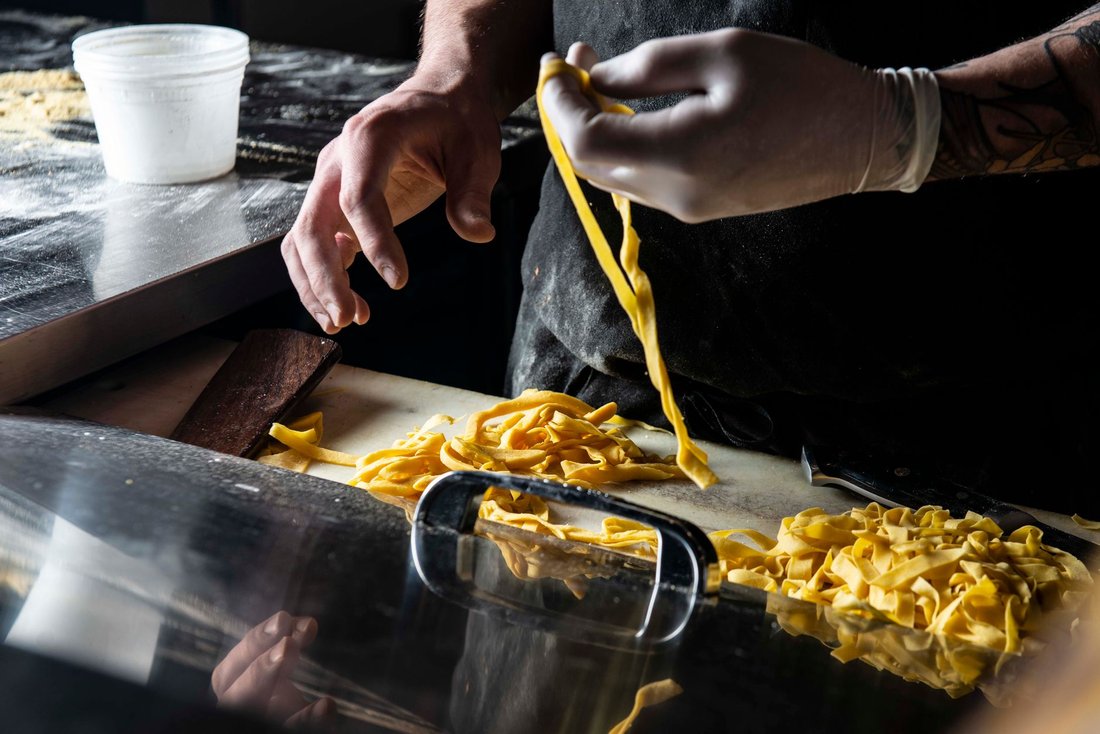
Handmade pasta is the clearest indicator of kitchen commitment because it cannot be faked and it cannot be rushed. When the restaurant is making its own tagliatelle, its own pappardelle, its own ricotta-filled something, someone is coming in early. That labor shows up on the plate in a way that dried pasta, even good dried pasta, simply does not replicate. Along Milwaukee Avenue and its side streets, you will find kitchens that have made that commitment. They tend to be the ones with shorter menus and slightly longer waits.
Reservations, Timing, and the Walk-In Question
Italian restaurants in Wicker Park fill up on weekends. The neighborhood draws from Lincoln Park, from the suburbs, from tourists who wandered up from Bucktown. If you have a specific place in mind, booking a week out is not paranoid. It is practical. Thursday night is often the sweet spot: the serious food crowd shows up, the room is full but not chaotic, and the kitchen is in its groove before the weekend sprint.
For walk-ins, the bar is your friend. Any restaurant worth eating at in this neighborhood will seat you at the bar without a reservation, and eating at the bar at a good Italian place is not a consolation prize. You see the kitchen expedite, you can ask the bartender what's good tonight, and you're not waiting forty-five minutes on the sidewalk in November.
Lunch is underutilized. A few of the stronger kitchens on the Milwaukee corridor run a lunch service that draws a fraction of the dinner crowd, with the same kitchen and a more compressed menu. Go on a weekday afternoon and you will eat better for less money with more space to think.
What to Order, and What to Skip
In any Italian restaurant, pasta is the test. Order one. If the kitchen is serious, the pasta will be cooked to a texture that dried pasta cannot achieve: slightly yielding, with a bite that gives before it surrenders. The sauce should coat the pasta rather than pool beneath it. When that first pasta is right, order another. Italian meals are built for this.
Secondi, the meat and fish courses, are where a lot of Italian restaurants in American cities lose the thread. Braised dishes are generally safer than grilled ones because they show the kitchen's patience and its understanding of time as an ingredient. A braise that has been going since morning is a different thing than a steak that went on the grill twelve minutes ago. A braised short rib or a slow-cooked pork shoulder on the menu is usually where the kitchen's real competence lives.
Skip the appetizers that are also available at every other restaurant in a two-mile radius. Burrata has been on every menu in Chicago for years. It is not a reason to choose a place. The kitchen that puts something less obvious on its antipasto list, something that requires sourcing, or technique, or a point of view about a specific Italian region, is the kitchen paying attention.
Dessert is where Italian restaurants often mail it in, and tiramisu is the tell. A tiramisu made in-house, that day, from good espresso and actual mascarpone, is one of the great things you can eat. A tiramisu that arrived in a plastic container from a supplier is not. You can usually ask. The answer will tell you something about the kitchen's priorities.
If you want to understand what's happening at the sharper end of Chicago's Italian dining scene, the broader city picture is worth knowing before you narrow to a neighborhood. And for the nights when the Italian instinct points toward dough and char, a good slice nearby is never far in this part of the city.
The six-corners will be busy when you get there. That's fine. The restaurants worth finding in Wicker Park are not hiding. They're just not advertising loudly, because they don't have to.